Ingredients
Vitamin C is three different molecules wearing the same name
L-ascorbic acid, its derivatives and the marketing term are not interchangeable. The differences in stability and pH explain why some serums work and others turn brown.

The points below about vitamin C serums are ordered by how much difference they make, not by how often they get repeated.
What matters most
- L-ascorbic acid needs a low pH and degrades readily on exposure to air and light.
- Derivatives are more stable but must convert in skin to be active.
- Colour change from clear to deep amber indicates oxidation.
The pure form and its constraints
L-ascorbic acid is the biologically active form and the one with the longest research history in topical use. It is water soluble, highly unstable in solution, and degrades on exposure to oxygen, light, heat and elevated pH.
To penetrate effectively it requires an acidic formulation, generally quoted as below about pH three and a half, which is also why it can sting. Concentrations in commercial serums typically run from ten to twenty per cent, with limited evidence that going higher adds anything. The combination of low pH and high concentration is exactly what makes these serums both potentially effective and frequently irritating.
Why serums turn brown
Oxidation converts ascorbic acid into dehydroascorbic acid and further breakdown products, which are progressively less useful and increasingly coloured. A serum that starts water-clear or pale straw and becomes deep amber has already lost a substantial share of its active content.
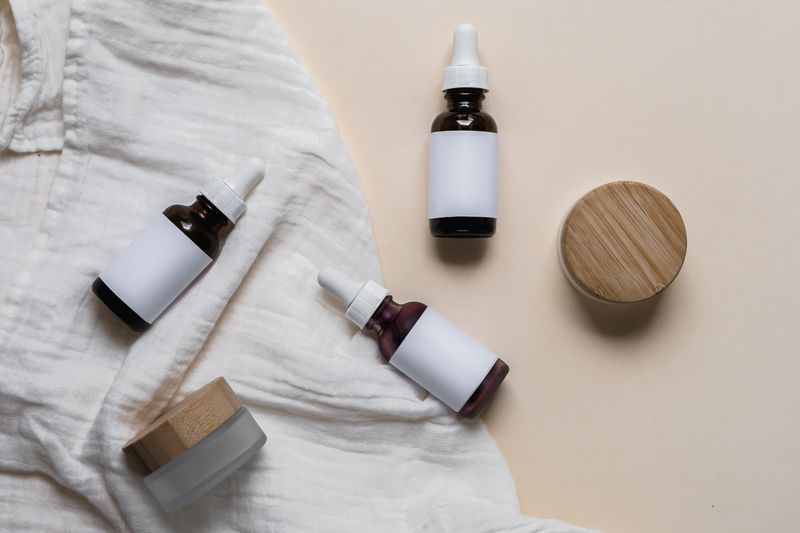
Once it darkens noticeably, the antioxidant benefit is largely gone even though the liquid still applies normally. This is why opaque airless packaging, small bottle sizes and cool storage all appear in sensible product design. A dropper bottle in a bright bathroom is close to a worst case for this molecule, whatever the price on the box.
The derivatives
Magnesium ascorbyl phosphate, sodium ascorbyl phosphate, ascorbyl glucoside, ethyl ascorbic acid and tetrahexyldecyl ascorbate are the common alternatives. They are more stable, tolerate higher pH, sting less and can be formulated into pleasanter textures, including oil-based ones.
By the end of a working day, the catch is that each must be converted into ascorbic acid by skin enzymes, and conversion efficiency varies between derivatives and is not always well characterised. The evidence base for derivatives is thinner than for the pure acid, which is a fair thing to say plainly rather than to gloss over. For reactive skin, a derivative that is actually tolerated will outperform a pure acid serum that lives unopened in a drawer.
What it is understood to do
Vitamin C acts as an antioxidant, neutralising reactive species generated by ultraviolet exposure and pollution before they can damage cell components. It is involved in collagen synthesis as a cofactor, which is the basis of the interest in its use for skin firmness over long periods.
Under makeup, it has been studied in relation to uneven pigmentation through effects on the pigment-producing pathway, though results in practice vary widely. It is frequently paired with vitamin E and ferulic acid, a combination studied for improved stability and complementary antioxidant activity. None of that constitutes a treatment for pigmentation disorders, which are medical matters best assessed by a dermatologist.
Using it without wasting it
Morning application is common because the antioxidant rationale pairs with daytime ultraviolet exposure, though it is not a substitute for sunscreen. Apply to clean dry skin and allow a few minutes before the next layer, since the low pH formula spreads awkwardly under some emulsions. Introduce it slowly if your skin is reactive, starting a few times a week rather than daily, and buffer with moisturiser if needed.
On a compromised barrier, store the bottle away from a sunny windowsill and close it properly, which sounds trivial and is the main determinant of shelf life. Give it two to three months of consistent use before judging it, as with most actives whose effects accumulate gradually.
Patch test anything new, and introduce one active at a time so you can tell what did what.
Reading a vitamin C label sceptically
The phrase vitamin C on the front tells you nothing; the INCI name in the list tells you which molecule you actually bought. A clear water-based serum containing L-ascorbic acid in a transparent dropper bottle is a formulation and packaging mismatch. Anhydrous formulas, where the ascorbic acid sits in an oil or silicone base with no water, avoid the stability problem differently.
Powder formats that you mix fresh solve stability at the cost of convenience and consistent concentration. Price correlates poorly with stability here, and packaging is the more honest signal.
Everything above, in order of what to do first
- The pure form and its constraints. L-ascorbic acid is the biologically active form and the one with the longest research history in topical use.
- Why serums turn brown. Oxidation converts ascorbic acid into dehydroascorbic acid and further breakdown products, which are progressively less useful and increasingly coloured.
- The derivatives. Magnesium ascorbyl phosphate, sodium ascorbyl phosphate, ascorbyl glucoside, ethyl ascorbic acid and tetrahexyldecyl ascorbate are the common alternatives.
- What it is understood to do. Vitamin C acts as an antioxidant, neutralising reactive species generated by ultraviolet exposure and pollution before they can damage cell components.
- Using it without wasting it. Morning application is common because the antioxidant rationale pairs with daytime ultraviolet exposure, though it is not a substitute for sunscreen.
- Reading a vitamin C label sceptically. The phrase vitamin C on the front tells you nothing; the INCI name in the list tells you which molecule you actually bought.
The takeaway
Check which molecule you bought, then check the packaging, because both decide whether anything survives to reach your face.
Sunscreen, consistency and time outperform nearly everything sold as a breakthrough.
Questions readers ask
Should I throw out a serum that has turned yellow?
Light yellowing is normal ageing and the product is likely still partly active. Deep amber or brown indicates substantial oxidation and little remaining benefit.
Can vitamin C be used with retinol?
Many people alternate them by time of day for comfort rather than chemistry. Using both at once is not dangerous but tends to increase irritation.
Also by Ayaan Kochhar
- How to read an INCI list, and where the order stops meaning anythingIngredients
- Retinoids are a family, and the ladder matters more than the brandIngredients
- Hyaluronic acid is a sponge, and a sponge needs somewhere to keep the waterIngredients
- Why pH decides whether an acid does anything at allIngredients