Makeup
Makeup over texture is a light problem, not a coverage problem
Adding more base to uneven skin makes the unevenness more visible, not less. What actually reduces the appearance of texture is changing how light falls across it.
There is a settled way of talking about makeup over skin texture. It is worth asking how much of it survives contact with the detail.
The argument in brief
- A raised or sunken edge is visible because of the shadow it casts.
- Product settling into a crevice outlines it more sharply.
- Diffuse light-scattering finishes reduce contrast at every edge.
Why texture is visible at all
Skin texture registers because raised areas catch light on one side and cast a small shadow on the other, creating local contrast. The eye is extremely good at detecting that contrast, which is why fine lines show under overhead light and vanish in soft window light. Colour has almost nothing to do with it, since a line and the skin beside it are usually the same shade.
That is why adding coverage does not help; opacity addresses colour differences and texture is not one. The variable worth changing is contrast, and everything that works on texture works by reducing it.
What makes it worse
Any product that settles into a crease fills the darkest part of it with material and sharpens the boundary rather than softening it. Fully matte finishes remove all surface reflection, which increases the relative contrast between a lit surface and a shadowed one. Heavy powder applied over a crease absorbs light where light was already scarce, making the line read as a drawn one.
Under makeup, building layers increases the total thickness on the surface, and thicker films crack and settle more readily through the day. Drying skin out beforehand roughens the surface, and rough surfaces scatter light unpredictably rather than evenly.
What genuinely helps
Satin and luminous finishes reflect a little light from every part of the surface, which lifts the shadowed areas and reduces contrast. Blurring primers containing light-scattering particles or silicone elastomers fill fine depressions and diffuse light across them. Well-hydrated skin is physically plumper at the surface, which reduces the depth of fine lines before any makeup is applied.
Thin, sheer application leaves less material available to settle anywhere, which is the opposite of the usual instinct. Choosing lower coverage with better finish is the trade that consistently improves how textured skin photographs and looks.
Application technique for uneven skin
Press and stipple rather than sweeping, because a sweeping motion pushes product into every depression it crosses. A damp sponge presses base into the surface and absorbs excess, which is why it outperforms a brush on textured areas. Warming a cream product between the fingers before application makes it thinner and less likely to bridge across a crease.
Under makeup, applying to the centre of the face and working outward puts the most product where texture is usually least visible.
Leaving the areas around the eyes and mouth deliberately lighter avoids the two places where settling shows first.
Powder used sparingly
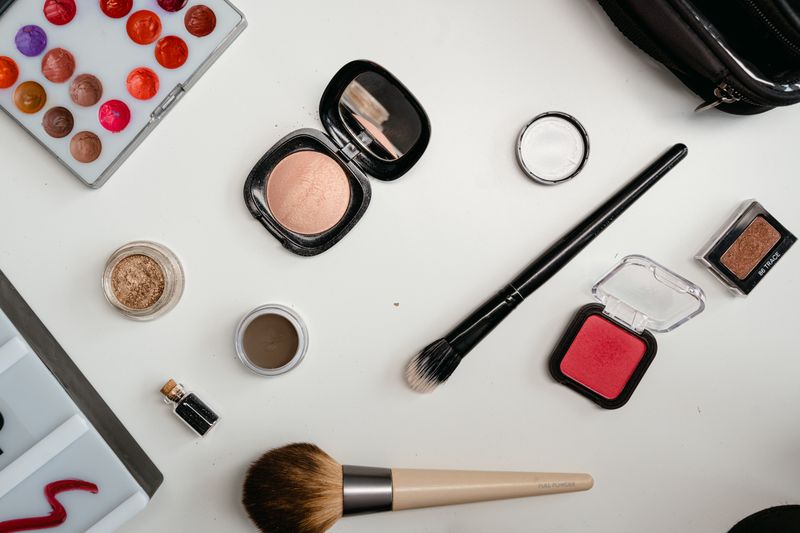
Powder is for controlling shine in specific areas, not for setting an entire face uniformly on skin with visible texture. A small brush applied only to the centre panel leaves the rest of the face reflecting light naturally.
On the ingredient list, pressing powder in with a puff and dusting away the excess leaves far less material than sweeping with a large brush. Finely milled translucent powders sit in creases less obviously than heavier pressed ones, and no powder avoids it entirely. A setting spray after powder melds the layer and removes some of the flat, dusty look that powder creates.
If you are pregnant, breastfeeding or using prescription treatment, check specific actives with a doctor or pharmacist before adding them.
Being realistic about the result
Makeup can reduce the contrast that makes texture visible, and it cannot remove the texture itself. The closer the light and the closer the viewer, the smaller the achievable improvement, which is why close-up photographs are unforgiving.
Skincare addresses texture over months rather than minutes, and hydration alone makes a same-day difference to fine lines. Persistent rough patches, scarring or raised lesions are dermatological questions rather than makeup ones. The most flattering approach on textured skin is usually less product applied better, which costs nothing to try.
The takeaway
Stop trying to cover texture and start trying to flatten the light falling across it.
A short routine you finish beats a long one you resent.
Questions readers ask
Should I use full coverage foundation to hide texture?
Generally no. Coverage addresses colour, and texture is a light-and-shadow problem. Thicker layers settle into creases and outline them more sharply.
Do blurring primers actually work?
They fill fine depressions and scatter light, which genuinely reduces contrast at small scales. They do nothing for deep lines or raised areas.
Also by Ridhima Passi
- Niacinamide is the least dramatic active on the shelf, which is why it stayedIngredients
- Preservatives are the reason your cream is not a petri dishIngredients
- Foundation matching fails on undertone far more often than on depthMakeup
- Foundation oxidation is real, and it is not usually the foundation's faultMakeup