Skincare
Patch testing works because reactions need time and a small stage
Trying a new active on your whole face is a bet with poor odds. A patch test is a cheap experiment, but only if you run it for long enough.

Everything here earned its place by changing an outcome. Nothing about patch testing a new product is included to round the number up.
What matters most
- Allergic reactions can take days to appear, unlike irritation.
- A small test area limits the cost of being wrong.
- One new product at a time is the only way to attribute a reaction.
Two different kinds of reaction
Irritant reactions are dose-dependent and can happen to anyone given a strong enough product, which is why a high concentration stings almost universally. Allergic contact reactions involve the immune system, occur only in people already sensitised, and can develop after a substance has been used happily for years.
The timing differs usefully: irritation tends to appear quickly, while allergic responses often surface a day or more after exposure. That delay is the whole reason a single application to the back of the hand tells you very little. Both present as redness and itching, so telling them apart at home is guesswork rather than diagnosis.
Running a test that means something
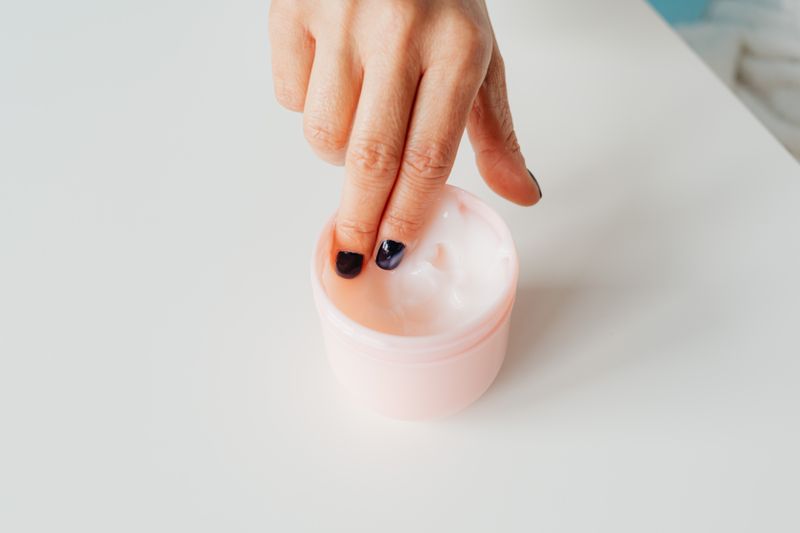
Apply a small amount to the same discreet patch of skin once a day for several consecutive days rather than testing once and declaring victory. The inner forearm and the skin just in front of the ear are common choices, the second being closer in character to facial skin. Use the product exactly as you would in the routine, since a rinse-off tested as a leave-on gives an answer to the wrong question.
Watch for redness, itching, small bumps, burning that does not fade within minutes and any spreading beyond the applied area. Keep the area free of other new products so that any reaction has only one plausible cause.
Why one product at a time
Introducing three new items in a week guarantees that any reaction is uninterpretable, and most people respond by abandoning all three. Adding one product and living with it for a week or two before the next is slower and generates real information.
On the ingredient list, it also reveals which product you actually liked, which matters when you eventually replace something. Actives deserve more caution than moisturisers, so stagger retinoids, acids and vitamin C rather than starting them together. A routine assembled this way is easier to repair, because you know the order in which everything arrived.
What a patch test cannot tell you
It will not predict clogged pores, since comedone formation takes weeks to become visible and does not show on a forearm. It will not predict how a product behaves in combination with the rest of a routine, particularly with other actives.
It cannot rule out a delayed sensitivity that develops after months of repeated use, which is how many contact allergies actually arise. It also cannot tell you whether a product will do what its marketing promises, which is a completely separate question. Treat it as a filter that catches obvious problems cheaply, not as a certificate of safety.
When to stop and see someone
A reaction that involves swelling, blistering, spreading well beyond the test area, or any difficulty breathing is an urgent medical matter. Persistent facial dermatitis that keeps recurring across different products is worth investigating properly, since patch testing in a clinic is a real diagnostic procedure.
By the end of a working day, dermatologists can test standardised panels of common allergens and identify a culprit that no amount of home trial and error would isolate. Fragrance mixes, preservatives and certain plant extracts appear repeatedly in those clinical panels, which is a useful hint when reading labels. If your skin reacts to a large share of what you try, that pattern deserves a professional opinion rather than a longer shopping list.
Patch test anything new, and introduce one active at a time so you can tell what did what.
Building a shortlist you can trust
Keep a simple written note of what you introduced and when, because memory reconstructs these sequences badly after a reaction. Photograph your skin in the same light every couple of weeks, since gradual change is invisible day to day.
Hold on to the packaging of anything that caused a problem so the ingredient list is available for comparison later. Over time you will notice recurring names across the products that suited you and the ones that did not. That personal pattern is worth far more than any general recommendation, including this one.
Everything above, in order of what to do first
- Two different kinds of reaction. Irritant reactions are dose-dependent and can happen to anyone given a strong enough product, which is why a high concentration stings almost universally.
- Running a test that means something. Apply a small amount to the same discreet patch of skin once a day for several consecutive days rather than testing once and declaring victory.
- Why one product at a time. Introducing three new items in a week guarantees that any reaction is uninterpretable, and most people respond by abandoning all three.
- What a patch test cannot tell you. It will not predict clogged pores, since comedone formation takes weeks to become visible and does not show on a forearm.
- When to stop and see someone. A reaction that involves swelling, blistering, spreading well beyond the test area, or any difficulty breathing is an urgent medical matter.
- Building a shortlist you can trust. Keep a simple written note of what you introduced and when, because memory reconstructs these sequences badly after a reaction.
The takeaway
Test small, test repeatedly, and change one thing at a time so the result can actually be read.
Skin changes slowly. Anything promising otherwise is selling the promise.
Questions readers ask
How long should a patch test run?
Several days of repeated application is a reasonable minimum, because delayed reactions are the ones a single test misses. Longer is better for anything strongly active.
Should I patch test a sunscreen?
It is worth doing if you have reacted to sunscreens before, since a specific filter or preservative may be responsible rather than the category.