Makeup
Colour correctors are the colour wheel applied to a face
Green, peach and lavender are not arbitrary. Each one cancels the colour opposite it, and using them well means using far less than most tutorials suggest.
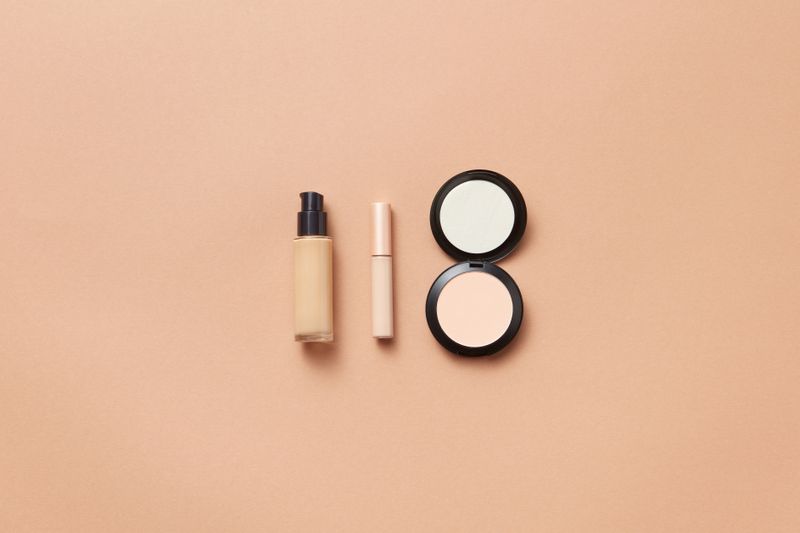
Everything here earned its place by changing an outcome. Nothing about colour correcting makeup is included to round the number up.
What matters most
- Complementary colours neutralise each other by mixing toward grey.
- Peach and orange counteract blue-toned shadow under the eye.
- Correctors go under base, not over it, and less always works better.
The principle underneath
Colours sitting opposite each other on the colour wheel neutralise one another when mixed, moving the result toward a neutral grey. Green sits opposite red, so a green-tinted product reduces the appearance of redness rather than covering it with opacity. Orange and peach sit opposite blue, which is why they address the blue-purple cast of under-eye shadow.
Lavender sits opposite yellow and is used to counteract a sallow cast, which is the least frequently needed of the three. Neutralising a colour means desaturating it, and the result is a duller version of the same area rather than a disappeared one.
Peach and orange under the eye
Under-eye darkness in many skin tones has a blue or purple character, caused by thin skin and visible vessels beneath. Applying concealer alone over that leaves a grey or ashy patch, because a light neutral shade over blue produces exactly that.
A thin layer of peach or orange first cancels the blue, and the concealer then covers a neutral rather than a coloured area. Depth matters more than most people realise, and the corrector should be roughly as deep as the darkness it is neutralising. Fairer complexions need a light peach, mid tones need a stronger peach and deeper complexions need a genuine orange.
Green for redness
Green correctors are the most widely sold and the most widely misused, largely because the effect is so easy to overdo. A very sheer green layer over a diffuse flush reduces the intensity, and anything more turns the area grey and obvious.
On the ingredient list, for localised redness a well-matched concealer often outperforms a corrector, since opacity beats neutralisation on a small area. Green primers across the whole face work for widespread redness and tend to look flat if the base over them is also matte. Persistent facial redness with visible vessels or bumps is worth discussing with a doctor rather than managing indefinitely with makeup.
Yellow and lavender
Yellow-toned correctors brighten purple-toned areas and are useful under the eye on some complexions where peach reads too warm. Lavender counteracts yellow and is used for a dull or sallow cast, most often on the centre of the face.
Both are subtle by nature, and the visible change is a shift in perceived brightness rather than any coverage. They are the two most commonly bought and least commonly needed correctors in most collections. If you cannot name the colour you are trying to cancel, you do not need a corrector for it.
Application order and quantity
Correctors go on skin before foundation and concealer, since their job is to change what the base has to cover. Applying a corrector over base disturbs the layer beneath and leaves a visible patch of unexpected colour. A quantity smaller than seems sensible is usually correct, and the layer should be almost invisible once blended.
Patting rather than dragging keeps the thin layer in place instead of spreading it across skin that did not need it. Setting lightly with powder before concealer prevents the two layers mixing into a muddy intermediate colour.
Patch test anything new, and introduce one active at a time so you can tell what did what.
When to skip them entirely
Mild discolouration is usually handled better by a well-matched concealer, since one product is thinner than two. Structural under-eye shadow caused by a hollow is not a colour problem, and a corrector cannot fill a depression. A brightening concealer a shade lighter than the base often achieves what people buy a corrector to achieve.
Under makeup, adding layers under the eye increases creasing, and the thinnest arrangement that works is always the best-looking one. Correctors are a specialist tool for a specific colour problem rather than a standard step in a base routine.
Everything above, in order of what to do first
- The principle underneath. Colours sitting opposite each other on the colour wheel neutralise one another when mixed, moving the result toward a neutral grey.
- Peach and orange under the eye. Under-eye darkness in many skin tones has a blue or purple character, caused by thin skin and visible vessels beneath.
- Green for redness. Green correctors are the most widely sold and the most widely misused, largely because the effect is so easy to overdo.
- Yellow and lavender. Yellow-toned correctors brighten purple-toned areas and are useful under the eye on some complexions where peach reads too warm.
- Application order and quantity. Correctors go on skin before foundation and concealer, since their job is to change what the base has to cover.
- When to skip them entirely. Mild discolouration is usually handled better by a well-matched concealer, since one product is thinner than two.
The takeaway
Name the colour you are cancelling before you buy anything, and you will need far less corrector than the shelf suggests.
A short routine you finish beats a long one you resent.
Questions readers ask
Why does my concealer look grey under my eyes?
A light neutral concealer over blue-toned shadow mixes toward grey. A thin peach or orange layer first cancels the blue so the concealer covers neutral skin.
Do I need a green primer for redness?
Only for widespread diffuse redness, and used sheerly. Localised red marks are usually better handled with a well-matched concealer.
Also by Ridhima Passi
- Niacinamide is the least dramatic active on the shelf, which is why it stayedIngredients
- Preservatives are the reason your cream is not a petri dishIngredients
- Foundation matching fails on undertone far more often than on depthMakeup
- Foundation oxidation is real, and it is not usually the foundation's faultMakeup