Makeup
Why makeup looks different in a shop and at your desk
Lighting changes which wavelengths reach your eye, and mirrors change the distance you judge from. Both conspire to make counter decisions unreliable.

Everything below about lighting and colour judgement comes from what actually happens rather than from what is supposed to.
What holds up in practice
- Light sources differ in spectrum, not just brightness.
- Metamerism makes two colours match under one light and clash under another.
- Daylight is the most useful reference because most days happen in it.
Light sources are not equivalent
A light source emits a particular distribution of wavelengths, and the colour you see is the product of that distribution and the surface reflecting it. Warm domestic bulbs are heavy in long wavelengths, which flatters warm tones and suppresses the appearance of cool ones. Older fluorescent tubes have spiky spectra with gaps, which is why skin can look sallow or grey under them.
Retail lighting is usually designed to make skin and products look appealing rather than accurate. None of these is wrong; they simply answer a different question from the one you were asking.
Metamerism explains the surprises
Two colours can reflect light in different patterns while appearing identical under one source and clearly different under another. This is why a foundation can match perfectly at the counter and read visibly wrong in an office or in daylight.
On the ingredient list, it affects foundation most, because the surrounding skin is the reference and the mismatch has nowhere to hide. Pigment combinations differ between brands, so two products of the same nominal shade can behave differently under the same light. The only defence is testing under the lighting you actually live in.
Testing properly
Take a sample or swatch to a window and look at it in indirect daylight, which is the closest practical approximation to a neutral reference. Photograph the swatch with the phone camera without flash, which flattens the effect of the room lighting somewhat. Check again after several hours, since both the base and your skin will have changed.
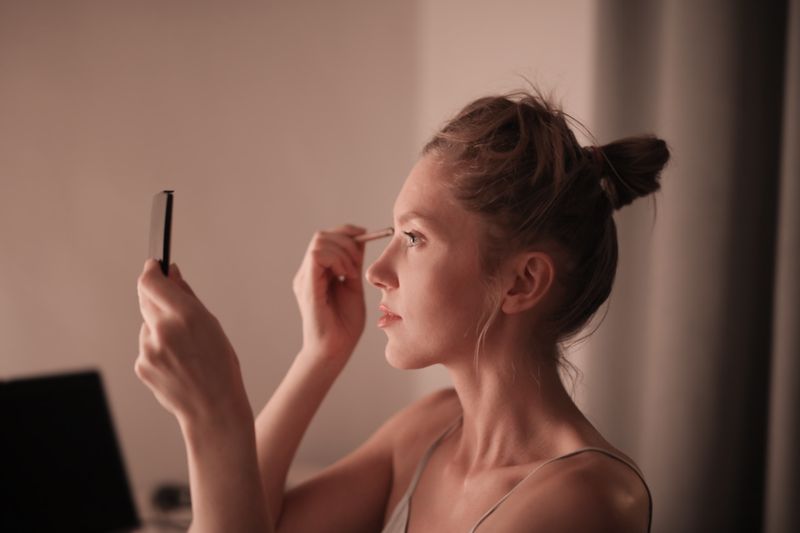
Judge from arm's length rather than close to a magnifying mirror, since nobody looks at your face from ten centimetres. If the shop will not provide a sample, buying from somewhere with a returns policy is the sensible alternative.
Your bathroom is also lying
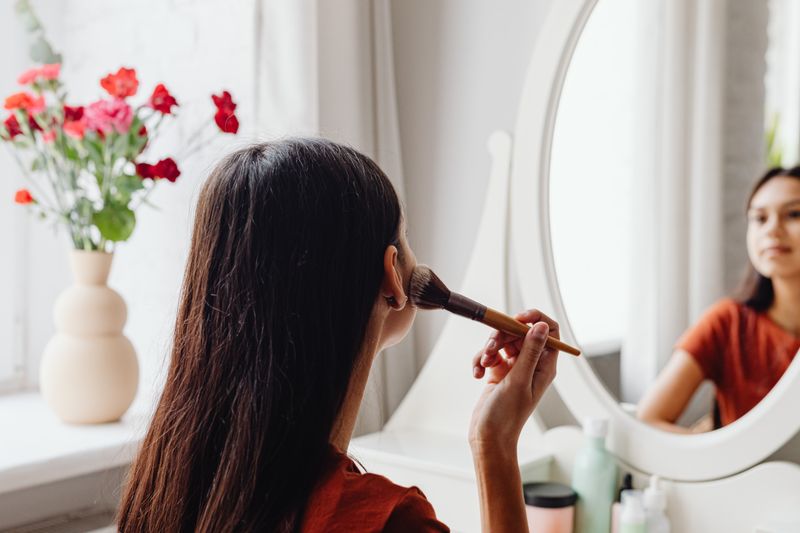
Most bathroom lighting is overhead, which casts shadows downward into the exact areas people are trying to assess. Downward shadows exaggerate under-eye darkness and nasolabial folds, which leads to over-application of concealer.
Front-facing light at face height is far more useful, and a window is the cheapest version of it. Ring lights produce very even illumination that flattens texture, which is flattering and misleading in equal measure.
Applying makeup in one lighting condition and living in another is the source of most surprises.
Flash photography changes everything again
Camera flash produces a burst of light much stronger than the ambient level and directly aligned with the lens. Products containing high levels of titanium dioxide or zinc oxide reflect that flash strongly, producing the pale cast known as flashback.
On a compromised barrier, translucent setting powders and mineral sunscreens are the usual culprits, and the effect is invisible in the mirror. Testing your intended face with a flash photograph before an event costs nothing and prevents an unpleasant discovery afterwards. Tinted powders and hybrid sunscreen formulas largely avoid the problem.
Practical rules
Match foundation in daylight, always, and treat every other lighting condition as a secondary check. Choose colour products in the light where you will most often be seen wearing them.
At the strengths actually sold, keep the number of light sources in your judgement consistent, so that changes you notice are real changes. Accept that no single shade will look perfect in every environment, because the physics does not allow it. Aim for a match that is close enough to be unremarkable everywhere rather than perfect in one place.
The takeaway
Judge everything by a window, because the counter lighting was designed to sell rather than to inform.
A short routine you finish beats a long one you resent.
Questions readers ask
Why does my foundation look grey in photos but fine in the mirror?
Light-scattering minerals in powders and sunscreens reflect flash far more than ambient light. Test with a flash photograph before deciding a shade is right.
Is daylight really the best reference?
It is the most useful one, because most of your day happens in mixed and natural light. Indirect daylight from a window is the practical version.
Also by Ridhima Passi
- Niacinamide is the least dramatic active on the shelf, which is why it stayedIngredients
- Preservatives are the reason your cream is not a petri dishIngredients
- Foundation matching fails on undertone far more often than on depthMakeup
- Foundation oxidation is real, and it is not usually the foundation's faultMakeup