Hair
Friction does damage you never notice happening
No single brush stroke, pillow turn or hair tie harms a strand. The count is what matters, and the count is far higher than anyone estimates.
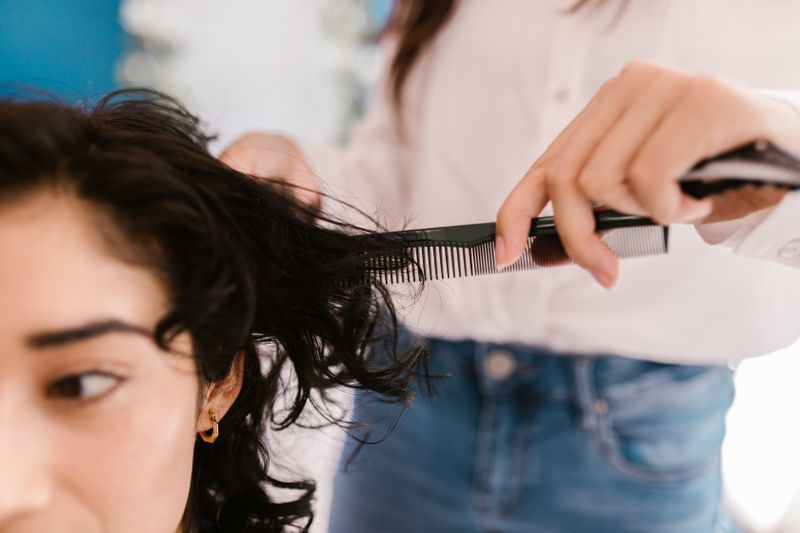
What follows is the working version of mechanical friction on hair: the decisions in the order you actually meet them, with the reasoning attached.
Before you start
- Cuticle scales lift and chip under repeated abrasion.
- Damage accumulates from thousands of small events rather than a few large ones.
- Smoother surfaces and looser tension reduce the load per event.
The cuticle and what abrades it
The outside of a hair is a layer of overlapping scales lying flat toward the tip, like tiles on a roof. When they lie flat the strand is smooth, reflects light well and slides past its neighbours easily. Abrasion lifts and chips those scales, and once a section is missing the cortex beneath is exposed to further damage.
A rough strand catches on its neighbours, which creates tangles, which requires more force to separate, which causes more abrasion. That feedback loop is why damage tends to accelerate rather than progress steadily.
Counting the events
Brushing twice a day for a year is well over seven hundred sessions, each involving dozens of strokes along the same strands. Sleeping applies friction against a pillow for several hours every night, with movement throughout.
After four to six weeks, a hair tie in the same position every day concentrates stress at exactly the same point on the same strands. None of these is individually harmful, and the tip of a long hair may have endured all of them for four years. Reducing the load per event by a small amount compounds across those numbers in a way that is genuinely worth doing.
Pillowcases and night friction
Cotton has a relatively rough surface at the fibre level and absorbs moisture from both hair and skin. Silk and satin surfaces have lower friction, so hair slides rather than catching as you move. The effect on any single night is negligible, which is exactly why it is worth doing every night.
Loosely braiding or tying hair up in a soft wrap reduces the total surface in contact with the pillow. Satin is a weave rather than a fibre, so a polyester satin delivers the friction benefit without the price of silk.
Ties, clips and tension
Elastic bands with metal joins catch and cut strands directly, and hair caught in the join breaks rather than releasing. Tight styles apply sustained tension at the follicle, which is uncomfortable and, maintained over years, is associated with hair loss at the hairline.
By the end of a working day, varying the position of a ponytail day to day prevents the same section taking the load repeatedly. Coiled and fabric-covered ties distribute pressure across a wider area than a thin elastic does.
Any style that causes headache, soreness or visible indentation is too tight and is worth loosening immediately.
Brushes and combs
Brushing distributes sebum from the scalp along the length, which is a genuine benefit for dry ends. It also applies friction to every strand it passes, so the useful range is a few passes rather than a hundred.
Boar bristle and smooth-tipped nylon are gentler than sharp plastic teeth with moulding seams still on them. Running a finger along a comb to check for rough edges takes five seconds and catches a surprising number of bad ones. Detangling is a job for a wide-toothed comb, and smoothing is a job for a brush, and swapping them causes problems.
If you are pregnant, breastfeeding or using prescription treatment, check specific actives with a doctor or pharmacist before adding them.
Clothing, bags and daily contact
Hair rubbing against a coat collar, a scarf or a bag strap experiences constant abrasion at whatever length reaches it. That is why many people find breakage concentrated at shoulder or mid-back length rather than distributed evenly. Wearing hair up on days involving a rucksack or a rough-textured coat removes a large share of that contact.
By the end of a working day, wool and rough synthetics are more abrasive than smooth fabrics, and a silk scarf under a wool one is a real solution. None of this requires new products, which is probably why it appears so rarely in advice about damaged hair.
The takeaway
Nothing in your routine breaks hair on its own, which is exactly why the small reductions are worth making.
A short routine you finish beats a long one you resent.
Questions readers ask
Do silk pillowcases actually work?
They reduce friction against hair as you move, which is a small effect repeated nightly. Satin weave achieves the same at a much lower price.
Is brushing my hair bad for it?
Not in moderation. It distributes sebum along the length. Excessive brushing, or brushing wet hair with a fine brush, applies friction with little benefit.