Lips
Cold dry air chaps lips, and licking them finishes the job
The mechanism is straightforward and so is the loop that keeps it going. What is happening at the surface, and why the obvious response makes it measurably worse.
Treat the sections below as a sequence. With chapped lips in cold weather, getting the early decisions right makes the later ones much easier.
Before you start
- Lip skin has no oil glands and loses water faster than facial skin.
- Saliva evaporates quickly and carries surface moisture with it.
- Digestive enzymes in saliva are not designed to sit on external skin.
What chapping actually is
The surface of the lip is a thin keratin layer with no sebaceous glands beneath it to supply protective lipids. Water leaves through that layer faster than through facial skin, and there is nothing arriving from below to replace it. As water content falls, the layer becomes stiff and brittle, and normal mouth movement cracks it rather than flexing it.
Cold air holds very little water, and heated indoor air holds even less once it warms up, so both halves of a winter day are dry. Wind adds forced evaporation on top, which is why an hour outdoors in a cold breeze does what a week indoors does not.
The licking loop
Licking deposits a film of saliva that feels immediately soothing because the surface is momentarily wet. Saliva is mostly water and evaporates within a minute, and evaporation from a surface takes additional heat and moisture with it. The lip ends up drier than before, which prompts another lick, and the cycle repeats several times an hour without being noticed.
After four to six weeks, saliva also contains digestive enzymes that break down proteins and starches, which is not a helpful thing to leave on external skin. Breaking the loop matters more than any product, and keeping a balm within reach is mostly a way of interrupting the habit.
What a balm can and cannot do
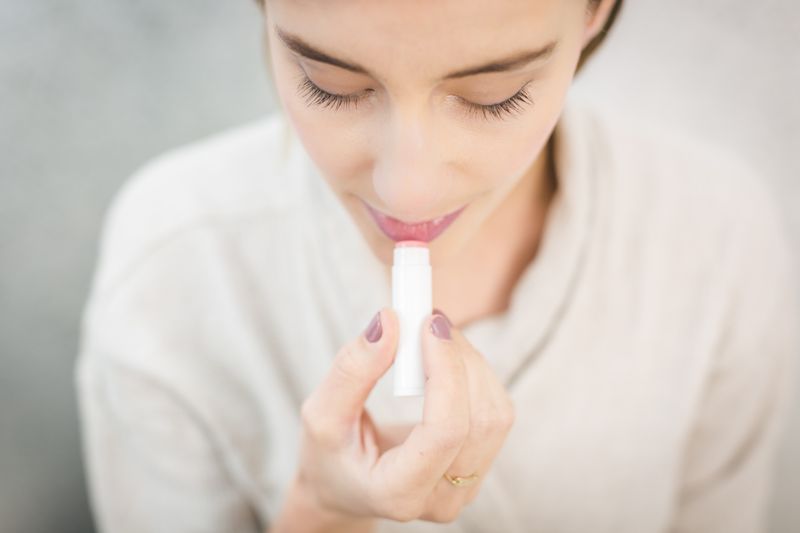
A balm supplies no water and works by slowing the rate at which water already present escapes. That means applying it to a lip that is already dry preserves dryness, and applying it after drinking or over a damp lip works better. Wax and petrolatum-based balms form far more complete films than oil-based ones and are the right choice in genuinely cold conditions.
Reapplication through the day is normal, since eating, drinking and talking remove the film continuously. A balm containing menthol, camphor, phenol or strong flavour can irritate an already damaged surface and prolong the problem.
Mouth breathing and other quiet causes
Sleeping with the mouth open passes dry air across the lips for hours, which is why some people wake with chapping every winter morning. Central heating and air conditioning both reduce indoor humidity substantially, and a bedroom is where the longest exposure happens.
Under makeup, certain medications are known to cause dryness, and a pharmacist can tell you whether yours is among them. Dehydration contributes in the ordinary sense, though drinking water does not fix a barrier problem on its own.
Sun exposure damages lips as it damages skin, and winter sun on snow is a well-known and underestimated dose.
Handling the peeling
Peeling skin on a chapped lip is attached at one end and pulling it removes living tissue along with the loose part. That produces bleeding, a longer healing time and a rougher surface that peels again within a day or two. Softening with a thick occlusive and leaving it alone allows the loose layer to detach when it is genuinely ready.
Scrubbing a chapped lip with sugar or a brush is the most common way people extend a problem by a fortnight. If peeling is constant regardless of care, that is worth a conversation with a doctor rather than a new product.
Persistent, painful or changing skin conditions belong with a dermatologist rather than a routine.
When it is not simple chapping
Cracking and soreness specifically at the corners of the mouth is a recognised and distinct problem with several possible causes. Persistent scaling, swelling, bleeding or a patch that does not heal over weeks should be assessed by a doctor. A reaction to a flavour, a fragrance or a specific ingredient can look exactly like chapping and will not respond to more balm.
By the end of a working day, repeated cold sores are a medical matter and a pharmacist can advise on what is appropriate. Anything painful, spreading or unresponsive belongs with a professional rather than with another tube from the shelf.
The takeaway
Seal a lip that already has water in it, and stop the licking, because those two things do most of the work.
A short routine you finish beats a long one you resent.
Questions readers ask
Does licking my lips really make it worse?
Yes. Saliva evaporates within a minute and takes surface moisture with it, leaving the lip drier than before and prompting the next lick.
Which balm works best in cold weather?
One built on wax or petrolatum forms a more complete film than a light oil. Applying over a slightly damp lip gives it something to hold in.