Lips
Lips are the gap in almost every sun protection routine
They have minimal pigment, no thickness and almost no products that protect them properly. The lower lip takes the most exposure of all.
Most explanations of sun protection for lips stop at the point where it starts to matter. This one carries on.
The short version
- Lip tissue carries very little melanin compared with facial skin.
- Most lip products contain no ultraviolet filters at all.
- Eating and drinking removes the film constantly.
Why lips are vulnerable
The vermilion has far less melanin than surrounding facial skin, so it has little of the pigment protection skin relies on. It is also thin, which means less material for ultraviolet to pass through before reaching living tissue. The lower lip projects slightly and faces upward more than the upper, so it receives noticeably more direct exposure.
Sun-related changes on lips appear predominantly on the lower lip for exactly that geometric reason. None of this is obscure, and yet lip protection is missing from the overwhelming majority of daily routines.
What most lip products do not contain
Ordinary balms, lipsticks and glosses contain no ultraviolet filters unless they explicitly say so. Glossy finishes may increase transmission of light into the tissue rather than reducing it, which makes gloss a poor choice for a beach day. Tinted products offer a little physical blocking through their pigment load, which is incidental rather than designed.
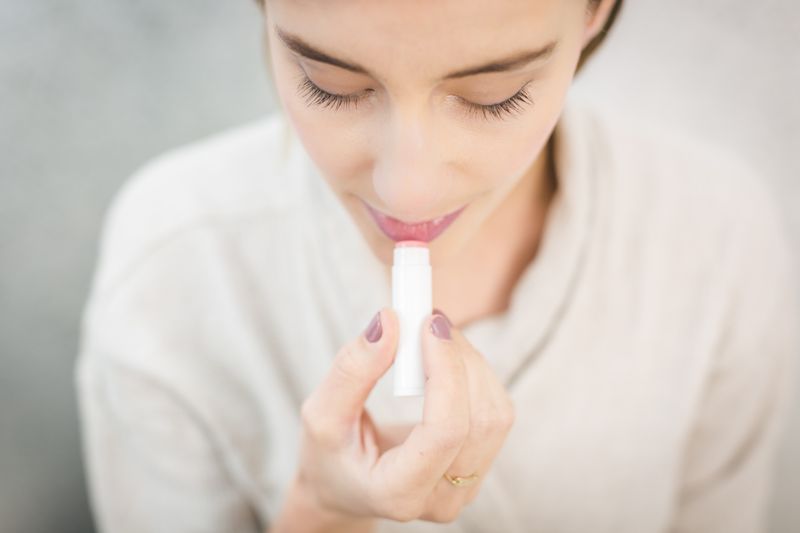
After four to six weeks, balms carrying an SPF figure exist in most markets and are the practical solution. They are tested at the same thick standardised layer as any other sunscreen, which is more product than people typically apply.
Reapplication is the real problem
Eating, drinking, talking and licking all remove the film from lips faster than from any other part of the face. A single morning application is close to meaningless for a day spent outdoors.
Reapplying after every meal and roughly every couple of hours in direct sun is the honest requirement. Keeping the balm somewhere you will actually reach for it is more useful than owning a better one you forget. For long exposure, physical shade from a wide-brimmed hat protects the lower lip more reliably than any reapplication schedule.
Filters on lip tissue
Some organic filters sting on lips, which is why several SPF balms rely on zinc oxide or titanium dioxide instead. Mineral filters can leave a visible pale cast on the lip, which is cosmetically noticeable but not a performance problem. Taste is a genuine obstacle, since a product on the lips is partly ingested during normal use.
On a compromised barrier, formulating for taste, texture, adhesion and protection at once is difficult, which is why this category is so thin.
Finding one you tolerate is worth some trial, because the alternative is no protection at all.
Higher risk situations
Snow, water and pale sand reflect ultraviolet upward, which strikes the underside of the chin and the lower lip directly. Altitude increases intensity, and winter sports combine both factors with cold air that already damages the lip surface.
Outdoor work, cycling and long walks accumulate exposure over years rather than over a single holiday. Some medications increase sensitivity to sunlight, and a pharmacist can tell you whether yours is among them. Anyone with a history of skin cancer should be discussing lip protection specifically with their doctor.
Formulation decides how an ingredient behaves, and the percentage on the front tells you less than it implies.
Signs to take to a doctor
A rough, scaly or persistently dry patch on the lower lip that does not resolve deserves medical assessment. A sore that fails to heal within a couple of weeks is a specific reason to make an appointment. Persistent loss of the sharp border between the lip and the skin above it is another change worth mentioning.
These are not things to self-diagnose from an article, and early assessment is straightforward. The point of describing them is to prompt a visit, not to provide a conclusion.
The takeaway
Keep a filtered balm within reach and reapply after every coffee, because the lower lip is taking the most and getting the least.
Sunscreen, consistency and time outperform nearly everything sold as a breakthrough.
Questions readers ask
Does lipstick provide any sun protection?
Opaque pigmented formulas block a little light physically, but this is incidental and unmeasured. Only a product with a stated SPF has been tested.
How often should I reapply an SPF lip balm outdoors?
After every meal or drink, and roughly every couple of hours in direct sun. Lips lose the film faster than any other part of the face.
Also by Tanya Sabharwal
- The skin barrier is a physical structure, not a marketing wordSkincare
- Mineral and organic filters reach the same result by different chemistrySkincare
- A moisturiser does three separate jobs, and most people only want twoSkincare
- AHAs and BHAs differ by solubility, and that decides where they can reachIngredients